Loading blog...
Automotive Supplier Document Automation: Closing the Chargeback Gap

Hasan Kanchwala
|
July 23, 2026
|
5 minutes read
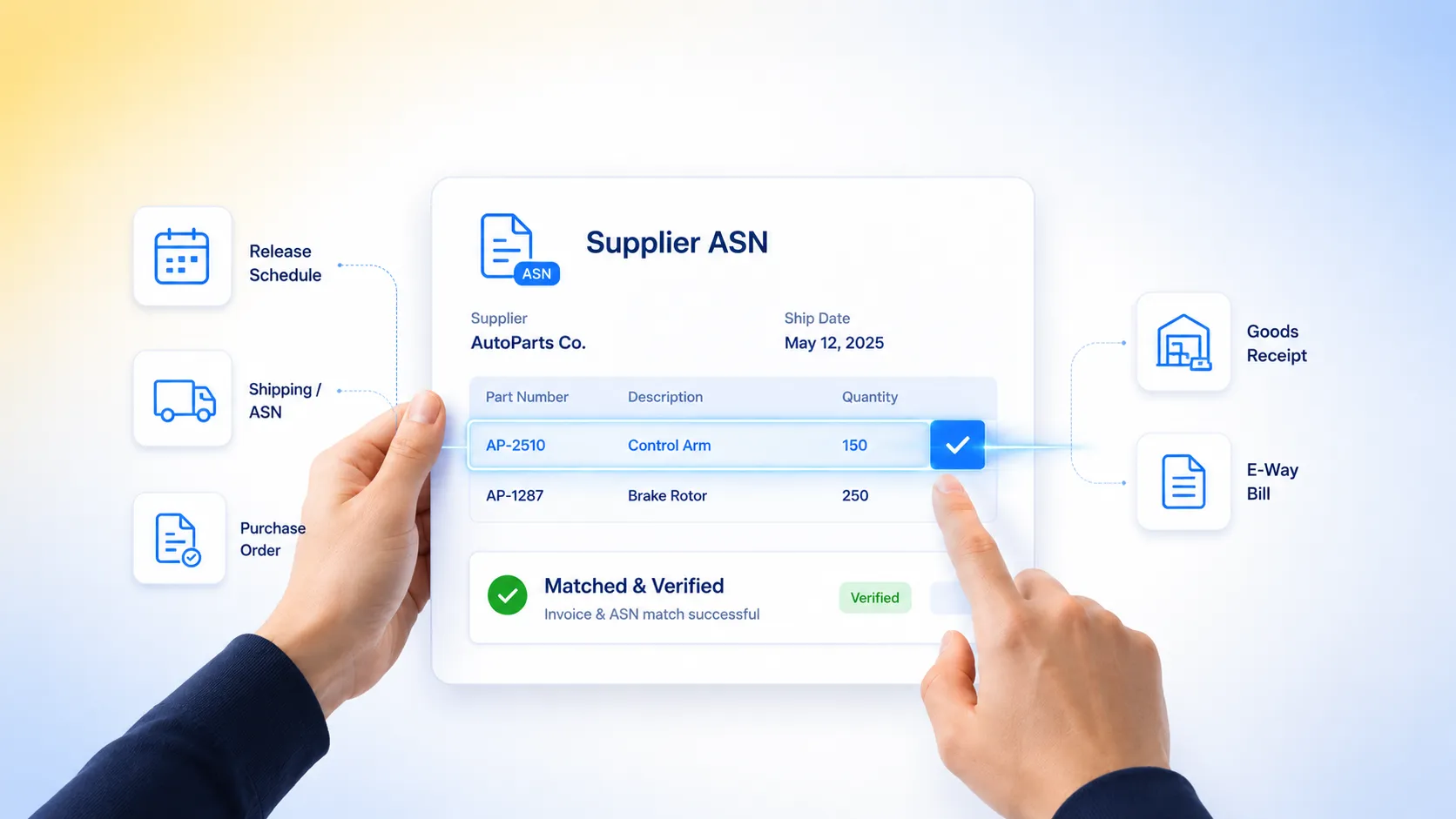
Automotive supplier document automation is how a component manufacturer keeps OEM paperwork from eating its margin. Every part that ships to an automaker drags a trail of documents behind it: purchase orders, release schedules, invoices, goods receipt notes, advance shipping notices, e-way bills, and quality records. For a tier-1 or tier-2 supplier, a single mismatch in that trail is not a filing problem. It is a chargeback, a held payment, or a line-stoppage penalty.
This guide is for the Finance Controller, plant finance lead, or supply-chain head at an auto component manufacturer who already processes thousands of these documents a month and knows the manual approach does not scale with what OEMs now demand.
| What is Automotive Supplier Document Automation?Automotive supplier document automation is the use of AI to extract, validate, and reconcile the documents that move through an automotive component supplier’s operations, including OEM purchase orders, release schedules, invoices, goods receipt notes, advance shipping notices, delivery challans, e-way bills, and quality records. For a tier-1 or tier-2 supplier it replaces manual data entry and checking with template-free extraction and rule-based verification, so each document is confirmed accurate and compliant before it moves forward. |
TD;LR
- Automotive supplier document automation uses AI to extract and verify the documents flowing through an auto component supplier, from OEM POs and schedules to invoices, GRNs, ASNs, e-way bills, and quality records.
- Auto OEMs push compliance and documentation requirements down the chain, but tier-2 and tier-3 suppliers carry that load with a fraction of the finance team. Call it the compliance cascade.
- In automotive, a document error is not just a delay. An ASN mismatch, a short shipment, or a missing quality record becomes an OEM chargeback or a line-stoppage penalty.
- The Chargeback Gap is the time between when a document error happens and when you catch it. Most suppliers catch it after the deduction has landed.
- Template-free extraction matters because every OEM and tier-1 sends a different format, and building a template per format never ends.
- Verification plus an audit trail is what turns extraction into compliance, including support for IATF 16949 documentation.
- KlearStack targets up to 99% accuracy and 95% straight-through processing within 90 days for document-heavy supplier operations.
The paperwork behind every auto part
The automotive supply chain is one of the most document-dense operations in manufacturing. A single shipment to an OEM can involve a purchase order, a rolling release schedule, an advance shipping notice, a delivery challan, an e-way bill, a tax invoice, and a batch of quality records, each of which has to agree with the others. Multiply that across hundreds of part numbers and dozens of customers, and a tier-1 supplier is reconciling tens of thousands of documents a month.
The scale of the industry makes this a structural problem, not an edge case. India’s auto component industry alone reached a turnover of around $80 billion in FY25, growing close to 10 percent year over year.
| 📊 An $80 billion document engineIndia’s automotive component industry turnover reached about Rs 6.73 lakh crore, roughly $80 billion, in FY25, up 9.6 percent year over year. Every rupee of that moves on documents that someone has to read, match, and file.Source: ACMA |
What we see across auto component finance teams is that the work is not just volume, it is variance. Each OEM sends its schedules and remittance advices in its own layout, and those layouts change without notice. The team that automated supplier invoices last year is back to manual handling the moment a customer redesigns its release format. The starting point for most suppliers is to automate supplier invoice processing before the volume becomes unmanageable.
Document AI that Eliminates Manual Processing and Compliance Gaps
The compliance cascade: OEM-grade paperwork, a fraction of the team
Here is the dynamic most coverage misses. Compliance in automotive flows downhill. When an OEM adopts a new traceability rule, an IATF 16949 documentation requirement, or an ESG reporting standard, it does not absorb that burden. It passes it to its tier-1 suppliers, who pass it to tier-2, who pass it to tier-3.
The requirement cascades. The capability to handle it does not. A tier-3 supplier can face nearly the same documentation and audit expectations as a global tier-1, with a finance team of three people instead of three hundred. That mismatch is where errors and missed deadlines accumulate, and it is why document processing in supply chain compliance has become a survival skill rather than a back-office nicety for smaller suppliers.
For a plant finance lead at a tier-2 supplier, the practical effect is a team that spends its month keying data and chasing mismatches instead of managing exceptions. The compliance cascade does not care how big your team is. It only cares whether the document was right.
The Chargeback Gap: when a document error becomes a deduction
In most industries, a document error costs you an exception to fix later. In automotive, it costs you money you may never get back. An ASN that does not match the goods received, a short shipment, a label or quality record that fails an incoming check, a tax detail that breaks reconciliation: each can trigger an OEM chargeback, a deduction, or in the worst case a line-stoppage penalty.
The assumption is that automating these documents is about going faster. The reality is that speed without verification just lets a wrong document reach the OEM faster. The win is not throughput, it is catching the discrepancy before the goods or the invoice move.
| ⚠️ The cost of catching it lateWhen a document error is caught after the OEM has issued a deduction, recovery becomes a dispute: weeks of emails, debit-note matching, and goodwill spent. The same error caught before dispatch is a thirty-second correction. In automotive, the timing of the check is the entire value. |
We call the time between when a document error happens and when you catch it the Chargeback Gap. Run a quick diagnostic on your own operation. Count the OEM deductions you absorbed last quarter that traced back to a document, ASN, or quality-record discrepancy. That number is your unpriced documentation risk, and closing the gap means moving the check upstream, to before the document moves rather than after the penalty lands. This is the same enforcement logic behind 3-way matching in accounts payable, applied to the supplier side of the auto supply chain.
Template-free extraction, because every OEM sends a different format
This is where the approach matters more than the accuracy claim. Template-based tools and most train-your-own-model platforms ask you to configure a layout for each document type and each customer format. In automotive, where every OEM and every tier-1 sends a different layout and changes it without warning, that configuration work never ends.
KlearStack runs template-free. New customer formats, new release-schedule layouts, and new vendor invoices process without template setup or IT involvement, because the self-learning model reads the document rather than waiting to be trained on it. Extraction alone, though, is only half the job. The other half is verification: confirming each document against the rules that apply to it, then keeping the audit trail an OEM quality audit or a tax assessment will ask for. That is the difference between AI document validation and simple data capture, and it is what makes the output defensible under regulatory and standards compliance, including IATF 16949 documentation expectations.
| 📊 60% of audit findings are documentation, not transactionsRoughly 60 percent of internal audit findings relate to inadequate documentation controls rather than the underlying transactions. For an auto supplier facing OEM and quality audits, that is the difference between a clean review and a corrective action.Source: The Institute of Internal Auditors |
Document AI that Eliminates Manual Processing and Compliance Gaps
From manual matching to 95% straight-through processing
The goal is to move documents through with less human touch while keeping the controls intact. In a supplier operation, that means most invoices, GRNs, and schedules clear automatically, and people handle only the genuine exceptions and the chargeback recovery that actually needs judgment.
Manual accounts payable already runs $15 to $40 per invoice before software, according to Ardent Partners research, and an auto supplier carries far more than invoices. Consider a tier-1 matching 8,000 OEM invoices and release schedules a month at 12 minutes each. That is roughly 1,600 hours, about ten full-time people, spent reading and matching. At 90 percent straight-through processing, fewer than 800 documents a month need a human, and that team shifts from data entry to managing exceptions and recovering deductions.
KlearStack targets up to 95 percent straight-through processing within 90 days, building from roughly 75 percent at day zero toward 85 percent through testing and up to 95 percent post launch. The mechanics carry over directly from straight-through invoice processing in other document-heavy industries, with the auto-specific layer being the OEM schedules and quality records on top of standard AP.
Where this fits, and where it does not
KlearStack already works with manufacturers across the automotive value chain, including Greaves and ArcelorMittal, so the fit on component and materials suppliers is grounded in real deployments rather than theory. It is the right tool when your operation is document-heavy, your customer formats keep changing, and a missed or wrong document carries a real financial penalty.
It is an honest non-fit in a few cases. If your shop processes a low document volume and a template tool already keeps up, automation is hard to justify. If your need is shop-floor MES, PLM, or engineering-drawing management rather than transactional and compliance documents, that is a different category of software. And if your priority is consumer-facing repair-shop invoicing, you are looking for billing software, not document automation. Knowing where the line sits is part of getting the procure-to-pay compliance decision right.
The bottom line
For an auto component supplier, documents are not back-office paperwork. They are the difference between a paid invoice and a disputed deduction, between a clean IATF audit and a corrective action, between a part that ships and a line that stops. The compliance cascade pushes more of that burden onto suppliers every year, and manual handling cannot keep pace.
Closing the Chargeback Gap means verifying every document before it moves, not after the penalty lands, and doing it without a template for every OEM format. For a Finance Controller or supply-chain head running thousands of documents a month, the practical next step is to watch KlearStack read and verify your own OEM and supplier documents, and reach up to 95 percent straight-through processing on the workflows that carry the most risk. Start with a demo using your own supplier documents.
FAQ
What is automotive supplier document automation?
It is the use of AI to extract, validate, and reconcile the documents that move through an automotive component supplier, such as OEM purchase orders, release schedules, invoices, goods receipt notes, advance shipping notices, e-way bills, and quality records. Instead of manual data entry and checking, each document is read and verified against business rules before it moves forward.
Which documents can be automated in an automotive supply chain?
Common ones include OEM purchase orders and release schedules, tax invoices, goods receipt notes, advance shipping notices, delivery challans, e-way bills, debit and credit notes, and quality records such as IATF-related documentation. The value is highest where these documents must agree with each other and where customer formats change often.
How does document automation help with OEM chargebacks and deductions?
Most chargebacks trace to a document or shipping discrepancy that was caught only after the OEM issued a deduction. Verifying each document against the matching rules before goods or invoices move catches those discrepancies upstream, which turns a weeks-long recovery dispute into a quick correction before dispatch.
Does automotive document automation support IATF 16949 compliance?
It supports the documentation and audit-trail side of IATF 16949 by verifying records against defined rules and keeping a complete, retrievable trail for quality and customer audits. It does not replace your quality management system, but it removes the manual documentation gaps that most audit findings come from.
Hasan Kanchwala
Hasan Kanchwala is a Senior Engineering Manager with expertise in full-stack development, AI-powered automation, and scalable software architecture. At KlearStack, he focuses on building secure and reliable intelligent document processing solutions that help enterprises automate document extraction, validation, fraud detection, and workflow management. His technical leadership combines product thinking, engineering strategy, and hands-on development to create scalable systems that improve accuracy, compliance, and operational efficiency.