Loading blog...
Fraud Detection in Salary Slip Verification Software: Methods and Benefits

Vamshi Vadali
|
July 31, 2026
|
5 minutes read
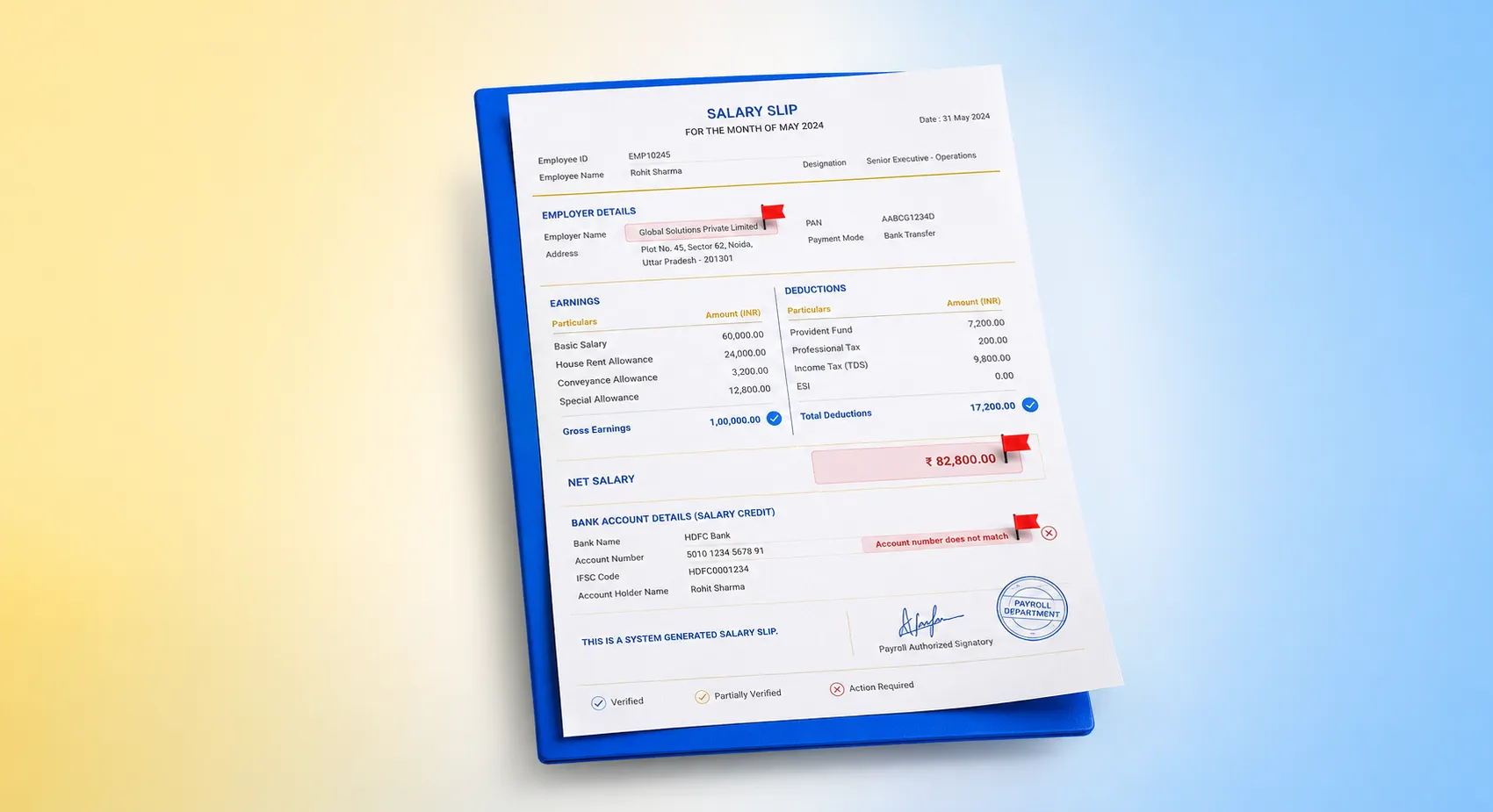
A fake payslip is not a paperwork problem anymore. In July 2024, the RBI issued revised Master Directions on Fraud Risk Management, consolidating 36 prior circulars and requiring every bank, NBFC, and cooperative lender to run a board-approved framework for Early Warning Signals and Red Flagging of Accounts. Income verification at loan origination sits squarely inside that mandate, which means a salary slip your team waved through on a visual check is not just a bad underwriting call. It is a gap in a system your regulator now expects you to have.
- Your underwriters eyeball a payslip for anything that looks off, and a well-executed fake, real template, only the numbers changed, passes a visual check every time.
- The last verification tool you evaluated checked the document but not the person, so a slip with internally consistent math still sailed through with no employer or income match anywhere.
- A flagged applicant with genuinely legitimate income gets auto-declined because the system has no way to explain why it flagged the file, and that rejection costs you the customer.
TL;DR
- Salary slip verification software catches fake payslips using metadata forensics, math reconciliation, and database cross-checks, not just a visual read.
- RBI’s July 2024 Master Directions put income verification inside a mandatory fraud risk framework, not a nice-to-have.
- Checks run in layers: document-level (metadata, math, fonts) plus cross-source (EPFO, Form 16/AIS, bank statements).
- Cross-verification cuts false declines; stricter auto-rejection just punishes legitimate applicants too.
- False positives carry a real cost: delayed approvals, lost customers, wasted investigation time.
- Fit depends on your gap: document forensics, database cross-referencing, or the extraction layer under both.
What Is Fraud Detection in Salary Slip Verification Software?
Salary slip verification software uses AI-based data extraction, machine learning, and forensic document analysis to identify fabricated, tampered, or inflated income documents before they reach an underwriting decision.
Key techniques include metadata and template analysis, mathematical validation of pay components, and cross-database verification against independent records, not just a cleaner-looking OCR pass over the same document.
Document AI that Eliminates Manual Processing and Compliance Gaps
Why This Is Now a Compliance Requirement, Not Just an Efficiency Tool
Early Warning Signals under the RBI’s framework are not limited to transaction monitoring after a loan is disbursed. They apply to the origination data itself, and income documents are one of the highest-volume, least-scrutinized inputs in that pipeline. A lender that cannot show how it screens salary slips for fraud is not just accepting bad loans. It is carrying an unaddressed gap in the exact framework regulators now audit against.
- The same audit-trail expectation applies broadly across regulated finance; our guide on financial services compliance software covers AML and KYC evidence requirements in full.
- This is one entry in a much larger operational risk picture; our guide on bank risk management maps where compliance and operational risk actually concentrate.
Methods of Fraud Detection in Salary Slip Verification
Detection works best as layers, not a single pass, the same layered principle behind automated data extraction generally. Document-level checks catch tampering inside the file itself; cross-source checks catch a document that is internally consistent but does not match the person’s actual financial footprint.
Core Detection Methods
Four layers, each catching a different kind of fabrication a visual check misses
| Method | What It Checks | Example It Catches |
| Metadata and Forensics | Scans PDF layers, creation dates, and editing software signatures | A payslip whose metadata shows it was edited in image software after issue |
| Math and Logic Checks | Recalculates gross pay, deductions, and net totals automatically | Deductions and net pay that do not reconcile against the stated gross |
| Font and Layout Inspection | Flags mixed fonts, pixel distortions, and text blocks that do not match official templates | A salary figure in a slightly different font than the rest of the document |
| Cross-Database Verification | Links data with EPFO UAN records, Form 16 or AIS, and bank statement APIs | A declared salary with no matching EPF contribution or bank credit history |
Cross-database verification is where credit documentation automation and salary slip fraud detection overlap directly, both depend on connecting a document to independent, authoritative data before a credit decision gets made.
Where a borrower’s income tax records are available, income tax return data extraction from Form 16 or AIS adds a third, independent reference point alongside EPFO and bank data.
Fraud Detection Coverage: Manual vs Automated
More layers is the point, a single visual check only ever applies one

Detection layers applied per payslip, manual review vs automated multi-layer system
Based on the four-method detection process outlined above
| Four Layers, One Workflow KlearStack runs metadata, math, template, and database checks as a single pipeline. → Book a Demo |
Benefits of Fraud Detection in Salary Slip Verification

- Speed: Reduces income verification from a manual review that takes hours or days to an automated check that returns a result in minutes.
- Fewer False Declines: Cross-verification routes genuinely ambiguous cases to human review instead of auto-rejecting every flagged file, which is where legitimate applicants get lost under stricter rule-based systems.
- Lower Default Risk: Catching inflated income at origination prevents the downstream delinquency that traces directly back to an income figure that was never real.
- Audit-Ready Evidence: Every check, source, and decision gets logged, the exact record a fraud risk audit or regulatory exam asks for.
Document AI that Eliminates Manual Processing and Compliance Gaps
What Happens When Verification Gets It Wrong
- A high false-positive rate is its own cost. Every wrongly flagged applicant is a delayed or lost approval, and a legitimate borrower does not wait around while your team clears a flag a better system would never have raised.
- Investigators spending time on false positives are not catching real fraud during that window, so an overly aggressive system can make total fraud exposure worse, not better, by burying real signal in noise.
- The fix is confidence scoring with a reason attached, not a blanket rejection. This same tradeoff shows up wherever document provenance matters; our guide on document chain of custody automation software covers how field-level evidence holds up under review.
Salary Slip Verification Platforms Compared
Most platforms in this space specialize in one layer of detection. Here is where each one actually fits.
Tartan
Intelligent payslip OCR with format recognition, multi-layer validation, and EPFO cross-reference, built for lending pipelines.
- Pro: The deepest published method breakdown in this category, covering format recognition through risk-scored output.
- Con: Every performance figure in its own published content is self-reported, with no third-party or independently audited benchmark to verify against.
TrueShield
AI pattern analysis flagging inconsistent fonts, misaligned elements, and unusual formatting in salary documents.
- Pro: Straightforward pattern-based detection that is easy to explain to a non-technical underwriting team.
- Con: Limited published depth on cross-database verification, the layer that catches a fake that is internally consistent.
HyperVerge
Salary slip verification grounded in real regulatory references, EPFO, Form 16/AIS, and the Account Aggregator framework, with a triangulation-based approach.
- Pro: The strongest regulatory grounding of the three, with real institutional references rather than marketing statistics, and direct coverage of legal consequences for submitting a fake payslip.
- Con: Published content stops short of quantifying detection accuracy or false-positive rates, leaving the actual performance of the triangulation approach unstated.
KlearStack
Template-free AI extraction with field-level validation, math reconciliation, and audit trails applied to salary slips and the broader loan document set.
- Pro: Runs salary slip verification inside the same extraction and validation pipeline as the rest of a loan file, not as a separate bolted-on fraud check, with field-level confidence scoring and an audit trail on every document.
- Con: KlearStack’s fraud signal is document and data-level; it does not run its own EPFO or Account Aggregator connections natively, so those cross-source checks integrate through your existing verification stack rather than replacing it.
Why Should You Choose KlearStack?
KlearStack was built for the document layer underneath lending decisions, and salary slip fraud detection is one workflow inside a larger BFSI document pipeline, alongside mortgage document automation and other income-verification-heavy lending processes.
- Template-free extraction and validation across payslips, bank statements, and supporting income documents
- Math reconciliation and metadata checks flag inconsistencies with the source rule attached, so reviewers know why a file was flagged
- Field-level audit trail on every document, the evidence an RBI fraud risk exam actually asks for
- Self-learning AI adapts to new payslip formats and employer templates without a rebuild
- GDPR and DPDPA compliant as standard, with data residency controls for regulated markets
| Catch the Math Before You Catch the Headline Book a demo using your own payslip formats and see what reconciles and what doesn’t. → Book a Demo for Your Lending Team |
Conclusion
Fraud detection in salary slip verification software works by layering checks a visual review cannot perform: metadata forensics, math reconciliation, template analysis, and cross-database verification against EPFO, tax, and bank records. As fake payslips get harder to spot by eye, that layered approach stops being optional and starts being what regulators expect a fraud risk framework to actually include.
The platforms in this space largely specialize in one layer, document forensics, pattern matching, or database triangulation. The right choice depends on which layer is your actual gap, and whether the platform can explain a flag clearly enough that your team trusts the automation instead of re-checking it by hand anyway.
FAQs
What is fraud detection in salary slip verification software?
Software that analyzes payslips for signs of tampering or fabrication using metadata inspection, mathematical reconciliation, and cross-database verification, before the income figure is used in a lending decision.
How does metadata analysis catch a fake payslip?
It examines a document’s underlying PDF properties, creation date, editing software signatures, and layer history, for signs the file was produced or altered outside a legitimate payroll system.
Can salary slip verification catch a fake that looks completely genuine?
Document-level checks alone sometimes cannot. Cross-database verification against EPFO, Form 16 or AIS, and bank statement history catches sophisticated fakes that pass a visual and even a metadata check by confirming the income independently.
Why do false positives matter in fraud detection systems?
An overly aggressive system delays or declines legitimate applicants, which costs the lender the customer and consumes investigator time that should go toward genuinely suspicious files. Confidence scoring with a clear reason code matters as much as raw detection accuracy.
Vamshi Vadali
Vadali Vamshi is a technology writer specializing in AI-powered document processing, intelligent automation, and OCR solutions. He helps businesses simplify complex document workflows through clear, insightful, and actionable content. Passionate about emerging trends in Document AI, Vadali writes extensively on how intelligent document processing accelerates efficiency and compliance across industries.