Loading blog...
Insurance Claims Fraud Detection Document Software: How It Works and Why It Matters

Hasan Kanchwala
|
July 31, 2026
|
5 minutes read
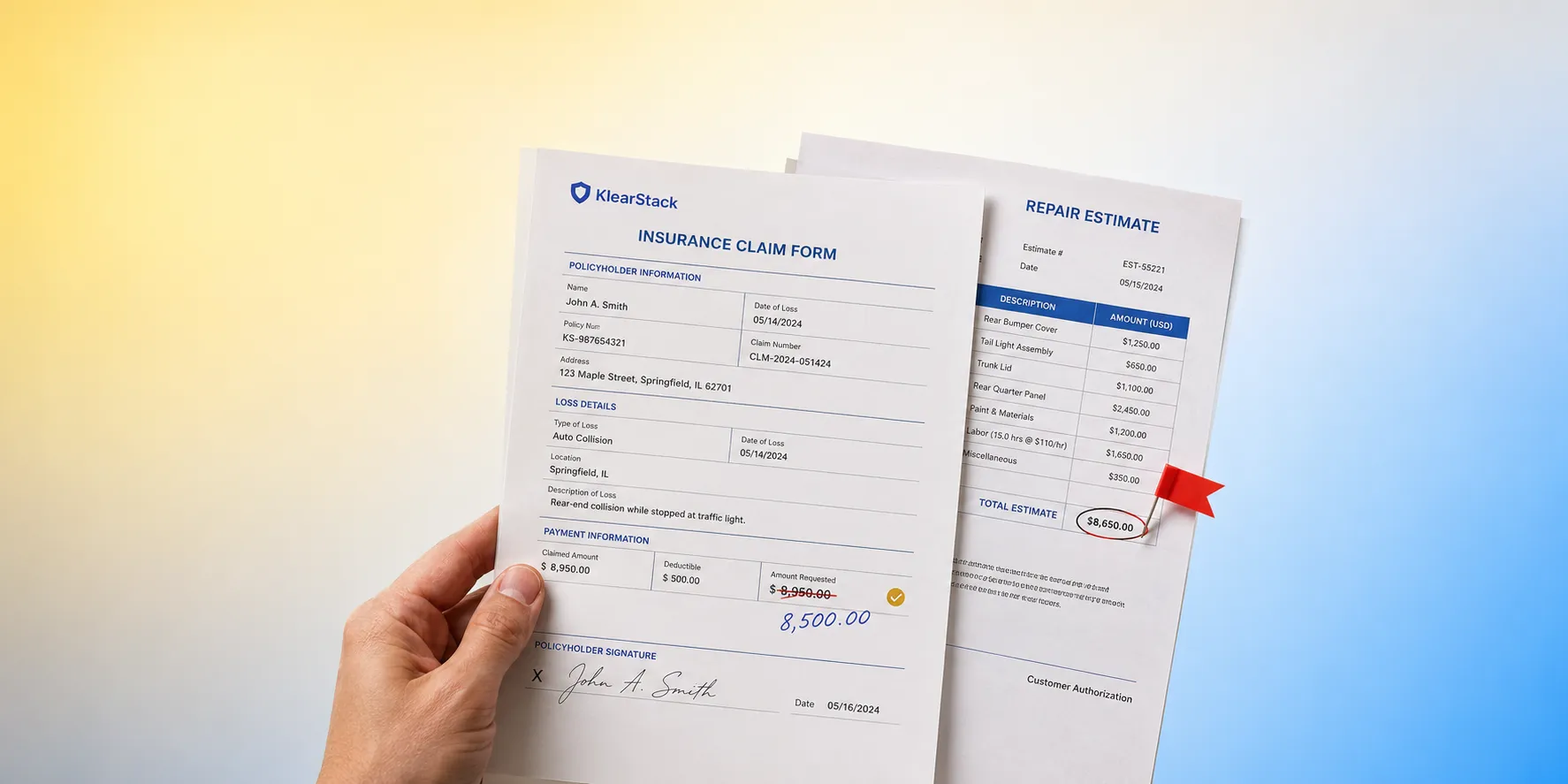
Non-health insurance fraud costs the industry more than $40 billion a year, and the FBI estimates it adds $4,000 to $7,000 to the average family’s premiums over a decade. Every one of those dollars traces back to a claim someone approved: a repair estimate that was inflated, a medical bill that was altered, a photo that was staged. The document sitting in your claims queue is where that $40 billion either gets caught or gets paid.
- Your adjusters eyeball repair estimates and medical bills for anything that looks off, and a well-edited photo or a cleanly altered PDF passes a visual check every time.
- Generative AI now makes a synthetic receipt or a doctored accident photo trivial to produce, and the fraud patterns your team was trained to spot five years ago do not cover what is arriving in the queue today.
- The fraud detection tool you evaluated flags so many legitimate claims that investigators spend more time clearing false positives than catching real fraud.
| See How KlearStack Catches What a Visual Review Misses Field-level validation and math reconciliation across every claims document, before payout. → Book a Demo |
TL;DR
- Fraud detection software layers image forensics, metadata checks, math reconciliation, and cross-document matching to catch tampering before payout.
- Non-health insurance fraud costs $40B+ a year, adding $4,000-$7,000 to family premiums over a decade (FBI).
- Generative AI has made fake documents easier to produce, raising the bar on detection.
- False positives carry a real cost: delayed payouts and investigators clearing flags instead of catching fraud.
- Most platforms specialize in one layer, image forensics, network analysis, or data validation, not all three.
- The right fit depends on which layer is your actual gap.
What Is Insurance Claims Fraud Detection Document Software?
Insurance claims fraud detection document software analyzes the documents submitted with a claim, repair estimates, medical bills, photos, receipts, and accident reports, to identify signs of tampering, fabrication, or inconsistency before a payout is approved.
It combines document AI, image forensics, and data validation to catch what a visual review misses: pixel-level edits, altered metadata, and numbers that do not reconcile.
For the technical foundation behind this kind of extraction, our guide on AI-based data extraction covers how fields are captured, scored, and logged.
Document AI that Eliminates Manual Processing and Compliance Gaps
How Insurance Claims Fraud Detection Actually Works
1. Capture and Classification: Documents from every channel, email, portal, scan, are standardized and automatically classified by document type before any check runs.
2. Image and Pixel Forensics: The system scans photos and scanned documents for copy-move edits, cloned pixel regions, and compression artifacts that indicate an image was altered after the fact.
3. Metadata Inspection: Embedded EXIF data (timestamp, device, GPS) and PDF authoring metadata (creation software, edit history, fonts) are checked for inconsistencies, like a photo timestamped after the claim was filed.
4. Math Reconciliation: Line-item totals, taxes, and subtotals on bills and estimates are automatically recalculated and compared against the stated total, catching manual tampering a visual scan would miss.
5. Cross-Document and Database Matching: The claim is checked against claims history and other submissions for reused templates, duplicate photos, or a pattern matching a known fraud ring.
6. Synthetic Content Detection: Increasingly, systems also check for signs a document or image was AI-generated rather than photographed or scanned from a real original.
Each check produces a confidence score, and the scores combine into a single fraud-likelihood ranking that routes the claim for automatic approval or human investigation.
What Each Detection Layer Actually Catches
Five layers, each catching a different kind of tampering a visual review misses
| Detection Layer | What It Checks | Example It Catches |
| Image & Pixel Forensics | Copy-move edits, cloned pixel regions, compression artifacts | A photo edited after the fact to show worse damage |
| Metadata Inspection | EXIF timestamps, device data, PDF authoring and edit history | A photo timestamped after the claim was filed |
| Math Reconciliation | Recalculates line-item totals, taxes, and subtotals | A repair estimate with a manually inflated total |
| Cross-Document Matching | Compares against claims history for reused templates or duplicate photos | The same staged photo submitted across two claims |
| Synthetic Content Detection | Flags AI-generated images or documents lacking real capture provenance | A receipt generated by an image model rather than photographed |
For the broader extraction workflow beyond fraud-specific checks, our guide on automated data extraction covers capture, validation, and archival in full.
Why Insurance Claims Fraud Detection Matters
The stakes are not abstract. Every dollar paid on a fraudulent claim moves directly into the premiums of every honest policyholder, and generative AI has closed the gap between what a fraudster can produce and what looks like a real document.
Fraud patterns detection software is built to catch:
- Exaggerated Damage Claims: Photos edited to show worse damage than actually occurred, common in auto and property claims.
- Manipulated Accident Reports: Handwritten reports and sketches altered or inconsistent with other evidence in the file.
- Inflated Treatment Invoices: Workers’ compensation and medical bills with line items added or amounts changed after the original document was issued.
- Fabricated Cancellation Claims: Travel insurance claims built around a fake illness or event, often supported by a doctored medical note.
| $40 Billion a Year Starts With One Document at a Time Catch the tampering before the payout, not after the audit. → Book a Demo |
The Buyer’s Real Question: Cost-Per-Claim, Not Just Fraud Caught
Fraud caught is not the number your CFO asks about first. Cost-per-claim to investigate is. A detection layer that catches more fraud but doubles investigation time per claim has not actually improved your unit economics, it has moved the cost from claims payout to claims operations.
- The metric that matters is not fraud detection rate in isolation, it is fraud detection rate against investigation cost per claim, the same cost-per-document logic that governs every other document-heavy BFSI operation.
- A platform that flags accurately but explains nothing forces every flagged claim through a full manual investigation, which is the expensive path regardless of how good the flag was.
- The platforms worth budgeting for are the ones that cut cost-per-claim by routing confidently, not just the ones with the highest fraud-catch rate on a vendor’s own benchmark.
For the accuracy and cost benchmarks behind this kind of case, our guide on financial data extraction automation covers the underlying document-processing economics.
Document AI that Eliminates Manual Processing and Compliance Gaps
What Happens When Fraud Detection Gets It Wrong
- A high false-positive rate is not a minor inconvenience. It is its own cost. Every wrongly flagged claim delays a legitimate payout and adds an investigation your team did not need to run.
- Investigators clearing false positives are not catching real fraud during that time, so an overly aggressive system can make total fraud losses worse, not better, by burying real signal in noise.
- The fix is not fewer checks. It is confidence scoring that tells an investigator why a claim was flagged, the source data and the rule that triggered it, not just that it was flagged, so review time goes to genuinely ambiguous cases instead of every flag equally.
This same false-positive tradeoff shows up in other document workflows; our guide on AI accounts payable software covers exception routing and duplicate-payment detection in full.
Fraud Detection Coverage: Manual vs Automated
More layers is the point here, not fewer touchpoints; the risk is applying them without explaining why a flag triggered

Detection layers applied per claim, manual review vs automated multi-layer system
Based on the six-layer detection process outlined above
| Flags That Come With a Reason, Not Just a Score KlearStack’s confidence scoring shows investigators exactly what triggered a flag. → Explore the Platform |
Why This Is a Compliance Officer’s Problem, Not Just SIU’s
Special Investigations Units own fraud detection day to day. But most states require insurers to maintain a documented anti-fraud plan under NAIC-modeled regulations, and when a state insurance department examines that plan, it is your compliance officer answering for it, not SIU alone.
- A fraud detection tool that cannot produce an audit trail showing what was checked, what triggered a flag, and how it was resolved is a gap your compliance officer inherits during an exam, whether or not SIU ever sees a problem.
- “The system flagged it” is not evidence. A documented rule, a source reference, and a reviewer decision is.
- Compliance officers evaluating fraud detection tools should ask the same audit-trail question they ask of every other regulated document workflow, not treat SIU tooling as exempt from it.
This is the same evidence standard applied elsewhere; our guide on document chain of custody automation software covers how field-level provenance holds up under audit.
The same audit-trail expectation applies broadly across regulated finance; our guide on financial services compliance software covers AML and KYC evidence requirements in full.
Insurance Claims Fraud Detection Platforms Compared
Most platforms in this space specialize in one layer of detection. Here is where each one actually fits.
Resistant AI
Sub-20-second API document verification designed to catch forged or synthetic claims packets.

- Pro: Very fast API verification suited for high-volume real-time claims intake.
- Con: Speed-focused positioning means deeper claims lifecycle features, triage, case management, sit outside its scope.
TrueDoc
Specializes in spotting screenshot laundering, font mismatches, and mathematical tampering in medical and repair bills.

- Pro: Sharp focus on the specific tampering patterns most common in medical and repair bill fraud.
- Con: Narrow document-tampering focus means broader claims risk scoring, network fraud, prior claims history, needs a separate tool.
Shift Technology
Combines anomaly detection, predictive modeling, and network analysis across the submission lifecycle.

- Pro: Strong network analysis catching fraud rings and cross-claim patterns, not just single-document tampering.
- Con: Broader risk-scoring focus means single-document forensic depth, pixel-level tampering, is less of the emphasis.
FRISS
Real-time property and casualty claims risk-scoring and triage automation.

- Pro: Built specifically for P&C triage at the point of intake.
- Con: Risk-scoring and triage focus, less depth on the document-forensics layer itself, metadata, pixel analysis.
Verisk ClaimSearch
A massive central data hub for cross-industry claims history and digital media forensics.

- Pro: The broadest claims-history data hub for cross-referencing a claim against industry-wide patterns.
- Con: Its strength is the data hub itself; document-level forensic analysis is typically paired with a dedicated tool alongside it.
Ocrolus
AI-driven document intelligence with data-level anomaly and tampering detection.

- Pro: Deep document intelligence with a strong track record in financial document analysis broadly, not insurance-only.
- Con: General financial document strength means insurance-specific claims workflows, adjuster routing, policy cross-check, are less the focus.
KlearStack
AI-powered document extraction with field-level validation and audit trails, applying the same forensic-grade accuracy to insurance claims documents that it applies to BFSI compliance documents.

- Pro: The same field-level audit trail and template-free extraction built for BFSI compliance applies directly to claims documents, catching math and data inconsistencies and creating a defensible audit trail for every flagged claim.
- Con: Because KlearStack’s fraud signal comes from document and data-level validation, image forensics, pixel and EXIF-level tampering detection, is a narrower slice of what dedicated forensic tools like Resistant AI or TrueDoc specialize in; the two are complementary, not fully overlapping.
A vendor’s own security posture is part of this evaluation too; our guide on ISO 27001 certified IDP software covers the certificate checks worth running on any of these platforms.
Why Should You Choose KlearStack?
KlearStack was built for regulated document workflows first, and claims documents carry the same requirement: prove the value, prove the source, prove the trail.
- Field-level extraction and validation across repair estimates, medical bills, and claims forms, with automatic math reconciliation
- Confidence-scored output flags inconsistencies with the source rule attached, so investigators know why a claim was flagged
- Field-level audit trail on every document, the evidence a regulatory or internal review actually asks for
- Self-learning AI adapts to new claim form formats without template rebuilds
- GDPR and DPDPA compliant as standard, with data residency controls for regulated markets
| Catch the Math Before You Catch the Headline Book a demo using your own claims documents and see what reconciles and what doesn’t. → Book a Demo for Your Claims Team |
Conclusion
Insurance claims fraud detection document software works by layering checks a visual review cannot perform: pixel-level image analysis, metadata inspection, math reconciliation, and cross-document matching, each producing a confidence score that routes a claim for approval or investigation. As generative AI narrows the gap between real and fabricated documents, that layered approach stops being optional.
The platforms in this space largely specialize in one layer, image forensics, network analysis, or data validation. KlearStack’s strength is the data and audit-trail layer specifically, the same validation discipline it applies to BFSI compliance documents, applied to the documents sitting in your claims queue.
FAQs
What is insurance claims fraud detection document software?
Software that analyzes claims documents, photos, bills, estimates, and reports, for signs of tampering or fabrication using image forensics, metadata inspection, and data validation, before a claim is paid.
How does it detect a doctored photo?
By checking for copy-move pixel edits, compression artifacts, and inconsistencies in embedded EXIF metadata like timestamp and device data, signs a visual inspection alone would miss.
Can it detect AI-generated documents and images?
Increasingly, yes. Detection systems check for the absence of real capture provenance and visual patterns characteristic of generative models, though this is an evolving area as generation techniques improve.
What causes false positives in fraud detection, and why does it matter?
Overly aggressive rules or thresholds flag legitimate claims for review. This delays honest payouts and consumes investigator time that should go toward genuinely suspicious claims, so confidence scoring with a clear reason code matters as much as detection accuracy itself.
Hasan Kanchwala
Hasan Kanchwala is a Senior Engineering Manager with expertise in full-stack development, AI-powered automation, and scalable software architecture. At KlearStack, he focuses on building secure and reliable intelligent document processing solutions that help enterprises automate document extraction, validation, fraud detection, and workflow management. His technical leadership combines product thinking, engineering strategy, and hands-on development to create scalable systems that improve accuracy, compliance, and operational efficiency.