Loading blog...
Insurance Fraud Monitoring Document Automation: How It Actually Works

Shweta K
|
August 12, 2026
|
5 minutes read
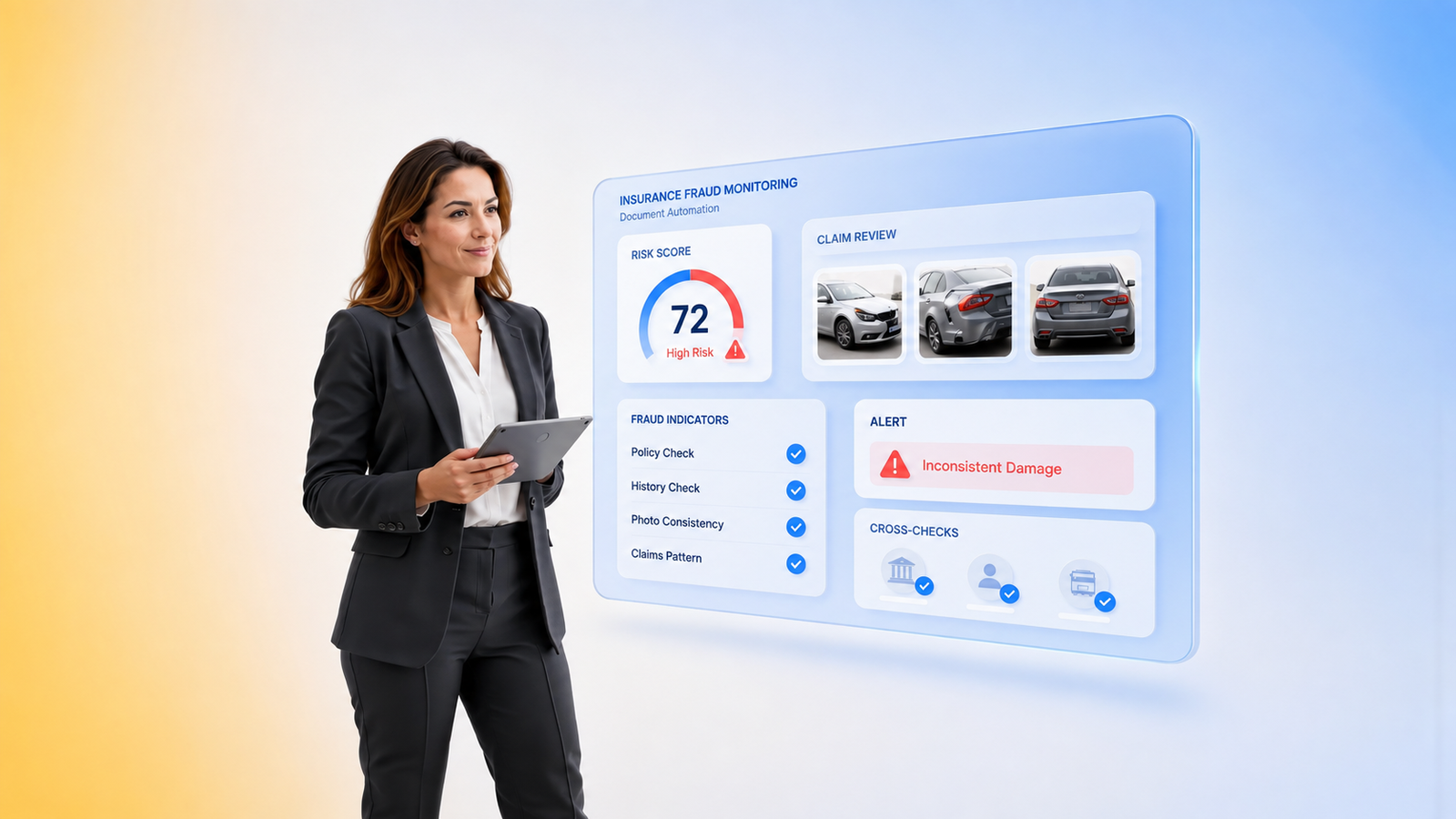
Quick Answer: Insurance fraud monitoring document automation is software that uses OCR, computer vision, and machine learning to extract, cross-check, and risk-score claims documents automatically, flagging forged or manipulated files before payout.
Key points covered in this article:
- What counts as document fraud in insurance claims
- Why isolated document scanning misses coordinated fraud
- How extraction, forensics, and risk scoring work together
- What good automation looks like versus a checkbox rollout
Insurance fraud monitoring document automation extracts, verifies, and risk-scores claims documents against policy and vendor records instead of relying on an adjuster to catch inconsistencies by eye. For SIU (Special Investigation Unit) teams and claims operations leads, that shift matters because document volume has outpaced manual review capacity for years. A report by the Coalition Against Insurance Fraud found that insurance fraud costs U.S. businesses and consumers over $308 billion a year, and a meaningful share of that flows through falsified or altered documents rather than outright invented claims.
This piece covers how the technology actually works, where the market’s usual pitch falls short, and what a properly implemented version of it looks like for a claims team buried in PDFs and photos. For a closer look at how the underlying extraction layer works across document types, see KlearStack’s intelligent character recognition glossary entry.
TL;DR
- Document fraud in insurance claims rarely fails at the document level alone – it fails when a document isn’t checked against the vendor master or policy history around it.
- OCR and extraction are the entry point for automation, not the fraud check itself; risk scoring and cross-referencing do the actual catching.
- Visual forensics on photos and scans catches manipulation that text-based review structurally cannot see.
- More documents scanned does not mean more fraud caught – a higher review volume with the same isolated-check logic just processes false confidence faster.
- Automation cuts claim processing time from days to minutes, but coordinated fraud rings still need a human investigator and link analysis on top of it.
- The teams getting the most value are the ones embedding document checks into FNOL intake, not running automation as a once-a-quarter audit.
What Is Insurance Fraud Monitoring Document Automation?
Insurance fraud monitoring document automation is software that ingests claims documents – invoices, medical bills, photos, repair estimates, identity documents – and automatically extracts, verifies, and risk-scores them for signs of fraud. It replaces the manual step where an adjuster or SIU analyst reads each file and decides, largely from experience, whether something looks off. The system does this at the document level and, in stronger implementations, at the claim level by checking documents against each other.
The core techniques are OCR for text extraction, computer vision for image and photo analysis, and machine learning models trained on prior fraud patterns to assign a risk score. BFSI claims teams and P&C insurers use it most heavily because their claim volume makes line-by-line manual review structurally impossible past a certain scale. A mid-size auto or health insurer processing several hundred claims a day cannot have every supporting document read manually within a reasonable settlement window.
Document AI that Eliminates Manual Processing and Compliance Gaps
Why Scanning More Documents Doesn’t Catch More Fraud
Most vendors in this space pitch higher OCR accuracy and faster extraction speed as the fraud-detection story. That framing is incomplete: a perfectly extracted, perfectly legible forged invoice is still a forged invoice, and extraction alone does not know that. The document has to be checked against something outside itself – the vendor master, the policy history, the claimant’s prior submissions – for the forgery to surface.
This is the gap that shows up most in claims fraud, not underwriting fraud: a repair estimate that reads cleanly through OCR can still be padded, and a medical bill can be legitimate in format but issued by a provider with no matching credentialing record. According toMcKinsey’s Claims 2030 research, more than half of current claims activities could be automated by 2030 – but that shift only reduces fraud exposure if the automation validates documents against each other, not just against a formatting template. A claims team that scans 10,000 documents a month with isolated checks has simply automated the blind spot, not closed it.
The fix is treating every incoming document as one node in a network: cross-referencing it against the vendor master, the policy’s existing document trail, and third-party data before a risk score is assigned. That is a fundamentally different build than an OCR pipeline with a fraud flag bolted on.
How Does Insurance Fraud Monitoring Document Automation Work?
Document automation for fraud works in three layers, applied in order: extraction → forensic analysis → cross-referencing.
1. Extraction
Pulls structured data out of unstructured formats:
- Names, amounts, dates, policy numbers
- Scanned PDFs, handwritten forms, photographed receipts
This is table-stakes. Most vendors handle it reasonably well by 2026.
2. Forensic Analysis
This is where photo and scan manipulation gets caught – checking pixel-level signals a person can’t see unaided:
| What it flags | What it catches |
|---|---|
| Metadata inconsistencies | Mismatched timestamps, device data, edit history |
| Cloning artifacts | Copy-pasted or duplicated image regions |
| Resolution mismatches | Claimed original vs. submitted photo quality gaps |
| Duplicate images | Same photo reused across unrelated claims |
Teams working with high-volume BFSI and claims document sets see the same pattern consistently: manipulation that slips past a human reviewer at a glance is exactly what visual forensics is built to flag.
3. Cross-Referencing
The final layer – and the most skipped one. Validates extracted data against:
- The vendor master
- Historical claims for the same policyholder
- Third-party sources (adverse-media, provider-credentialing databases)
A document can pass extraction and forensics cleanly and still fail here – if the vendor doesn’t match records, or the claim pattern resembles known fraud rings.
The outcome: Risk scores combine all three layers. Only flagged, high-risk claims route to a human SIU investigator. Legitimate claims move through untouched.
What Changed in Insurance Document Fraud Automation in 2026
The shift in 2026 is where the check happens, not just how it happens. Insurers are moving document validation into FNOL (first notice of loss) intake itself, catching a forged or manipulated document at submission instead of during a post-claim audit weeks later. That timing change is what actually protects payout budgets – a fraud flag raised after settlement is a recovery problem, not a prevention.
Common Mistakes Insurers Make When Automating Fraud Document Checks
Insurers rolling out document automation tend to repeat the same three mistakes, and each one traces back to treating the tool as an extraction upgrade rather than a fraud-detection system. The first is deploying OCR without connecting it to the vendor master or policy history, which produces fast, clean, and fraud-blind extraction. The second is over-tuning risk thresholds for volume reduction instead of accuracy, which pushes false-positive rates up and burns SIU investigator time on legitimate claims.
The third mistake is treating automation as a one-time audit tool instead of a standing intake control. A quarterly document review catches fraud after the money has already moved; an intake-level check catches it before approval. Claims teams that skip straight to “how fast can this process a document” without asking “what is this document being checked against” end up with a faster version of the same blind spot they had manually.
Document AI that Eliminates Manual Processing and Compliance Gaps
What Good Insurance Fraud Document Automation Looks Like
Good implementation looks structurally different from a basic OCR-plus-flag setup, and the difference shows up in what gets checked, not just what gets scanned.
| Basic document scanning | Proper fraud monitoring automation |
| Extracts data, flags obvious formatting errors | Extracts data and cross-checks it against vendor master and policy history |
| Reviews each document independently | Reviews documents as part of a connected claim file |
| Flags based on static rules | Risk-scores based on patterns, history, and forensic signals combined |
| Runs as a periodic audit | Runs at FNOL intake, before payout approval |
| High false-positive rate on legitimate claims | Routes only genuinely high-risk claims to SIU, fast-tracks the rest |
Even well-built document automation has a real limit worth stating plainly: it catches document-level and single-claim anomalies reliably, but coordinated fraud rings spreading legitimate-looking claims across multiple policies and providers need link analysis and human investigation on top of it. Document automation narrows what SIU teams have to look at manually – it does not replace the investigation for organized fraud.
| Still routing every claims document through the same manual review queue regardless of risk level? See how document-level and cross-document checks run in one pass. |
Why KlearStack for Insurance Fraud Monitoring Document Automation?
KlearStack’s document AI platform was built around the gap most fraud-detection tools skip: validating the vendor master and every supporting document together, not scoring the invoice or claim form in isolation. For claims and SIU teams, that means:
- Cross-checks extracted claims data against the vendor master automatically, not as a separate manual step
- Applies computer vision to catch forged, manipulated, or duplicated photos and scans across submitted evidence
- Risk-scores each document and routes only high-risk claims to human investigators
- Handles handwritten forms, scanned PDFs, and photographed receipts without a fixed template
- Adapts to new document formats without manual reconfiguration when a provider or vendor changes their layout
KlearStack processes claims and AP documents for BFSI and logistics teams handling high daily volumes, and applies the same vendor-master cross-referencing logic that catches padded repair estimates and unverifiable providers in insurance claims. Compared to point-solution OCR tools that stop at extraction, KlearStack’s cross-document validation is what actually surfaces the fraud pattern, not just a legible file.
| If your SIU team is still cross-referencing vendor details by hand after a document clears OCR,see how that check runs automatically instead. |
Conclusion
Insurance fraud monitoring document automation only works when it checks documents against each other, not just against a formatting standard. Extraction and forensics catch the document that looks wrong; cross-referencing against the vendor master and policy history catches the document that looks right but isn’t.
For claims and SIU teams, that means the real gain isn’t faster scanning – it’s fewer legitimate claims sitting in an investigator’s queue and fewer forged ones clearing payout. Teams evaluating this now should ask any vendor exactly what a document gets checked against, not just how quickly it gets read.
FAQs
What is insurance fraud monitoring document automation?
Insurance fraud monitoring document automation is software that extracts, verifies, and risk-scores claims documents using OCR, computer vision, and machine learning. It flags forged or manipulated files automatically. It routes high-risk claims to human investigators. Legitimate claims move through without manual review.
How does AI detect fraud in insurance documents?
AI detects insurance document fraud through three layers: extraction, forensic analysis, and cross-referencing. Extraction pulls structured data from the document. Forensic analysis checks photos and scans for manipulation signals. Cross-referencing validates data against the vendor master and policy history.
Can document automation reduce false positive fraud flags?
Yes, properly tuned document automation reduces false positives by combining risk signals instead of relying on a single rule. It weighs extraction, forensic, and cross-reference results together. Systems tuned only for speed tend to raise false positives instead. Accuracy-focused tuning is what actually lowers them.
Is document automation enough to stop insurance fraud?
No, document automation alone is not enough for coordinated fraud. It reliably catches document-level and single-claim anomalies. Fraud rings spreading claims across multiple policies need link analysis and human investigation on top of it. Document automation narrows the investigator’s workload rather than replacing it.
Shweta K
Shweta K is a Technical Content Strategist with expertise in B2B SaaS content, governance, risk and compliance (GRC), and technical writing for compliance-heavy industries. At KlearStack, she focuses on translating complex capabilities in intelligent document processing, fraud detection, audit trails, and regulatory compliance into clear, audience-focused content. That content reaches enterprise and BFSI buyers, including compliance teams and internal audit leaders, at the right stage of their journey. Her approach combines market and competitive research, content strategy, and precise technical writing to build authority, make GRC and compliance topics easy to act on, and drive qualified engagement.