Loading blog...
What is Straight Through Processing in Insurance: Benefits and Implementation for 2026

Vamshi Vadali
|
July 28, 2026
|
5 minutes read

If you work in insurance, you already know how your company handles millions of documents every single year. Every claim form, policy application, and underwriting decision creates a paper trail that someone needs to process, review, and file away. But does this give rise to the need of straight through processing in insurance?
McKinsey research indicates that up to 95% of property and casualty policies could undergo straight through processing without underwriter involvement, representing a massive automation opportunity.
You might be wondering:
- How can insurance companies reduce processing times from days to minutes while maintaining accuracy?
- What happens when manual workflows create bottlenecks that frustrate customers and increase operational costs?
- Why are leading insurers investing heavily in automation technologies to stay competitive in 2025?
The insurance industry stands at a turning point where straight through processing (STP) offers solutions to these pressing challenges. Advanced technologies like artificial intelligence and machine learning now make it possible to automate complex insurance workflows that previously required extensive human intervention.
Companies implementing STP alongside intelligent document processing report significant improvements in processing speed, cost reduction, and customer satisfaction while maintaining the accuracy and compliance standards essential to insurance operations.
TL;DR
- STP enables automatic insurance workflow completion without manual intervention.
- Processing times reduce from days to minutes for routine claims and applications.
- Implementation requires system integration and staff training on automated workflows.
- Leading insurers achieve improved satisfaction and operational savings through STP.
- AI and machine learning power modern STP accuracy and decision capabilities.
- Success depends on starting with high-volume, standardized processes before expanding.

What is Straight Through Processing in Insurance?
Straight-through processing (STP) in insurance is an automated workflow model that carries policy issuance, underwriting decisions, and claims settlements from start to finish without human intervention. It relies on digital technologies, artificial intelligence, machine learning, and API integrations, to move and validate data instantly, handling claims, underwriting, and policy issuance using models trained to make decisions that previously required human expertise.
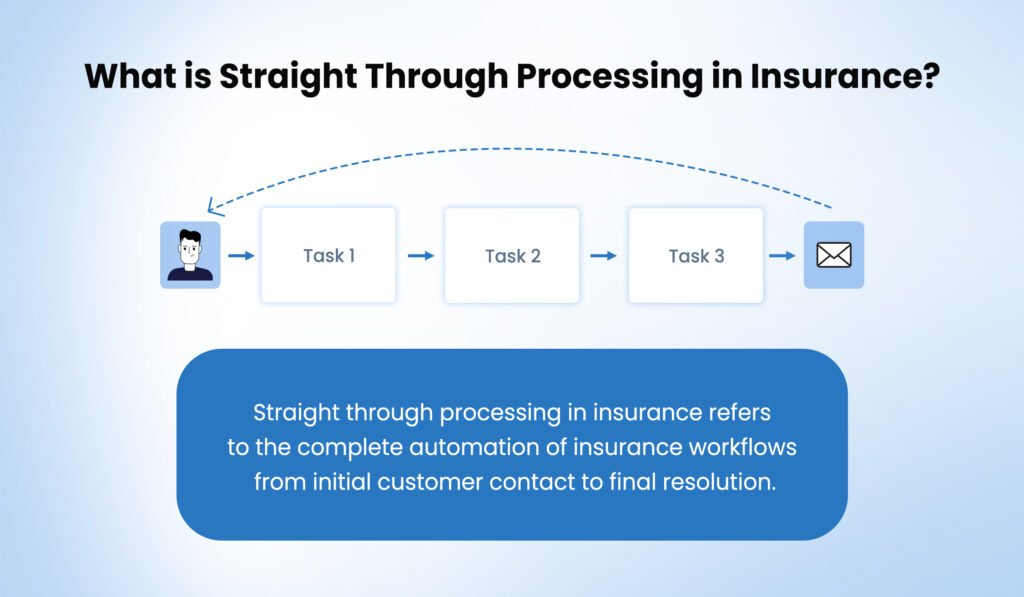
None of that works without a reliable read on the incoming document first. STP depends on AI-based data extraction to turn a policy application, claim form, or supporting document into structured data before any rule or model can act on it.
Traditional vs. STP Processing Models
The same workflow, run two different ways
| Traditional Manual Processing | STP Automated Processing |
| Document receipt and manual sorting | Automatic document capture and classification |
| Data entry by administrative staff | Intelligent data extraction using OCR and AI |
| Review by multiple specialists | Real-time decision-making through algorithms |
| Manual decision-making processes | Instant routing to appropriate systems |
| Physical file routing between departments | Digital workflow management with audit trails |
| Book a Free Product Demo See how KlearStack turns incoming documents into STP-ready data. → Get Free Demo |
Document AI that Eliminates Manual Processing and Compliance Gaps
Core Applications in Insurance
Three functions carry most of the volume STP is built to handle.
- Underwriting: Automates risk evaluation and data gathering, checks coverage limits and underwriting guidelines, and issues policies instantly for standardized personal and commercial lines.
- Claims Adjudication: Handles first notice of loss intake, verifies policy and coverage status, runs automated fraud scoring, and settles low-severity claims without manual review.
- Data Validation: Uses OCR and ICR extraction, digital forms, and rules engines to eliminate manual data entry errors and missing-field delays.
How Straight Through Processing Works in Insurance Operations
1. Capture: Multi-channel document capture, OCR conversion of physical documents, and API connections for real-time data feeds bring every input into one queue.
2. Classify and Extract: The system identifies document type, policy applications, claim forms, medical records, supporting documentation, and extracts data despite format variation.
3. Apply Business Rules: Extracted data flows through rule-based decision trees and machine learning models that mirror human underwriting and claims judgment, including risk assessment and fraud detection.
4. Decide and Route: Based on rule evaluation, the system generates the output, claim approval, policy quote, coverage confirmation, or an exception report routed to a human reviewer.
Standard cases resolve through rule-based decision trees; anything outside defined tolerances routes to a human, with a full digital audit trail attached at every step.
Key Benefits
- Speed: Reduces claims processing and policy issuance from days or weeks to minutes for routine, standardized transactions, with instant response on customer inquiries.
- Accuracy: Minimizes manual data entry and reduces error rates through standardized, rules-based decision criteria and a consistent audit trail.
- Efficiency: Lowers operational costs and frees staff to handle complex, high-value, or ambiguous cases instead of routine data entry.
Process Cost Comparison
Where the savings actually come from
| Process | Manual | STP | Savings |
| Document Processing | High labor intensity | Automated extraction | 60-80% reduction |
| Decision Making | Multiple reviewer time | Instant algorithms | 70-90% faster |
| Error Correction | Rework and delays | Prevention-focused | 50-70% fewer errors |
| BY THE NUMBERS Up to 95% of property and casualty policies could undergo straight-through processing without underwriter involvement Source: McKinsey & Company, How Data and Analytics Are Redefining Excellence in P&C Underwriting |
| See Where Your Operation Sits Against These Numbers Test STP against your own claims and underwriting volume. → Book a Demo |
Document AI that Eliminates Manual Processing and Compliance Gaps
Technology Components Powering STP Insurance Solutions
AI and machine learning foundations:
- Pattern Recognition: Identifies similarities between cases for consistent handling.
- Risk Assessment: Evaluates multiple data points to determine approval likelihood.
- Fraud Detection: Spots suspicious patterns indicating fraudulent activity.
- Predictive Analytics: Forecasts claim costs and processing complexity.
Document processing and data extraction:
- OCR: Converts scanned documents into searchable text.
- ICR: Handles handwritten text and forms, the same handwriting recognition problem that shows up in adjuster notes and older policy documents.
- Computer Vision: Analyzes images and photos for damage assessment.
- Natural Language Processing: Understands context and meaning within documents.
Integration and workflow layers tie this together with API-based connections, workflow engines that route cases, exception handling for complex escalation, and audit trail capabilities built for financial services compliance software requirements, not bolted on afterward.
Common Insurance Processes Suitable for STP Implementation
High-automation potential:
- Personal Lines Policy Processing: Standardized application formats, clear underwriting guidelines, high volume.
- Property Damage Claims: Photo-based damage assessment, standardized repair cost databases, predictable workflows.
Moderate-automation potential:
- Commercial Underwriting: Partial automation; complex risk factors still require human expertise.
- Large Claims: Limited automation; high-value cases need detailed investigation.
- Specialty Insurance: Selective automation; unique coverage terms limit standardization.
Customer service and support:
- Policy information inquiries, payment processing and scheduling, coverage change requests, and claims status updates all handle well under STP.
Implementation Challenges and Solutions for Insurance STP
Legacy system integration:
- Data format incompatibilities, limited API capabilities, processing speed constraints, and security vulnerabilities are the most common blockers, and they are exactly what a vendor’s own ISO 27001 certification should already account for before integration even starts.
- Middleware platforms, gradual migration, hybrid processing during transition, and custom API development are the standard fixes.
Change management and staff training:
- Resistance to workflow changes, fear of displacement, and quality-control concerns are the predictable human factors, addressed through structured education, hands-on practice, and role redefinition rather than a single rollout announcement.
Regulatory compliance and audit:
Decision transparency, complete audit trails, data privacy protection, and automated regulatory reporting are non-negotiable requirements, not optional add-ons. The same evidence discipline applies across regulated finance broadly; our guide on bank risk management maps where this kind of operational and compliance risk actually concentrates.
| Explainable AI, Not a Black Box Decision KlearStack logs source, extraction confidence, and every rule applied, ready for audit. → Book a Demo |
Why Should You Choose KlearStack for Straight Through Processing?
Advanced processing capabilities:
- Template-free processing adapts to any insurance document format automatically, ACORD forms, policy applications, claims documentation, including handwritten and legacy formats, across multiple languages and regional variations.
- Self-learning AI improves with each document processed, learning from corrections and adapting to new document types automatically.
Proven insurance industry performance:
- Processes 10,000+ documents daily with consistent accuracy, completing document processing in minutes rather than hours.
- Achieves up to 99% extraction accuracy across all document types, with scalability that holds through peak processing periods.
- Seamless API integration with existing policy administration systems, built-in compliance controls, secure handling with a full document chain of custody, and real-time exception reporting.
Conclusion
Straight through processing represents a fundamental shift in how insurance companies handle routine operations, moving from manual, time-intensive processes to automated, efficient workflows.
The technology offers clear benefits through faster processing times, reduced operational costs, and improved customer experiences that directly impact business competitiveness.
The insurance industry continues moving toward greater automation, and companies that invest in STP technologies now will be better positioned to compete effectively in 2025 and beyond.
FAQs on Straight Through Processing in Insurance
What is meant by straight through processing in insurance?
Straight through processing in insurance automates complete workflows from customer input to final resolution. This technology handles claims, underwriting, and policy processing without manual intervention using AI and machine learning.
How does STP reduce insurance processing costs?
STP reduces costs by eliminating manual data entry and review tasks. Automated systems process routine cases faster than human staff while maintaining accuracy standards and freeing employees for complex work.
What types of insurance processes work best with STP?
Standard personal lines applications, property damage claims, and routine policy changes work well with STP. High-volume, standardized processes with clear business rules show the greatest automation benefits.
Can STP systems handle complex insurance claims automatically?
Current STP systems handle straightforward claims automatically but escalate complex cases to human reviewers. AI software solutions like KlearStack can handle more sophisticated scenarios while maintaining quality control standards.
Vamshi Vadali
Vadali Vamshi is a technology writer specializing in AI-powered document processing, intelligent automation, and OCR solutions. He helps businesses simplify complex document workflows through clear, insightful, and actionable content. Passionate about emerging trends in Document AI, Vadali writes extensively on how intelligent document processing accelerates efficiency and compliance across industries.