
CLAIMS AND FRAUD CONTROL TEAMS
Insurance Fraud Detection That Catches the Edited Bill Before Payout
Hospital bills, discharge summaries, lab reports, death certificates and repair invoices are checked for edits, duplicates and mismatches on arrival, with every flag logged for your investigators.
- 1,000+ Forensic Checks Across Document Types
- Runs Beside Your Claims System, On-Premise or Cloud
















Where Insurance Claims Fraud Hides in the Paperwork
Each row names the issue, the check that flags it and the team it reaches.
Hospital bills and pharmacy receipts are checked for altered amounts, cloned regions and pixel-level edits, and the changed field is marked on the page.


What Extraction Tools, LLMs, and AI Agents Can't, KlearStack Can.


OCR, IDP Tools and LLM Agents
Extraction reads the document. Claim assessment also needs checks against your rules and evidence of altered fields.
- Extracted fields need validation
- Rules need a separate review step
- Deployment options vary by provider
- Audit evidence needs to be assembled

Every document is read, then checked against your policies, standards and rules, with tampering and duplicates flagged in the same pass and logged.
- Rule checks and forensics, one pass
- Every flag names the check
- On-premise and private cloud deployment
- Field-level audit trail, ready for review
Forensic Checks Across Document Types
Applicable checks flag edits, cloned regions and pixel changes in claim documents.
Faster Turnaround Time
A verified platform metric across deployments. Measure the change on your claim files in the Free PoC.
Documents Processed
Platform-wide across banking, trade and supply chain documents.
Why Insurers Add KlearStack Beside Their Claims Analytics
Your analytics scores the claim. KlearStack checks the documents inside it.
Every Flag Shows the Field
Each flag marks the field or region that failed, and the check that caught it.
On-Premise Ready
Claim files hold health and identity data. Every check, AI included, can run inside your network.
Checks and Forensics in One Pass
Bill totals, date rules and forensic checks run together, before the file reaches an assessor.
Your Team Signs Off
Each check follows a rule you set and a person makes the call, with every decision logged.
Free Proof of Concept
Run last month's closed claims and see which documents the checks would have flagged.
Fraudulent Claims Caught at the Document, Before Payout
Give every page consistent checks, inside the claims flow your team already follows.
Before KlearStack

Glance at Intake
Assessors scan the bill for the total and the stamp. Subtle edits can pass visual review.

Red Flags Pick the File
Investigation starts when a score or a tip points at a claim. Other documents may get less scrutiny.

Field Visits for Proof
Checking a doubtful bill can mean calls to the hospital or a site visit.

Findings Lost in Email
Why a claim was paid or repudiated sits across emails and notes, hard to show later.


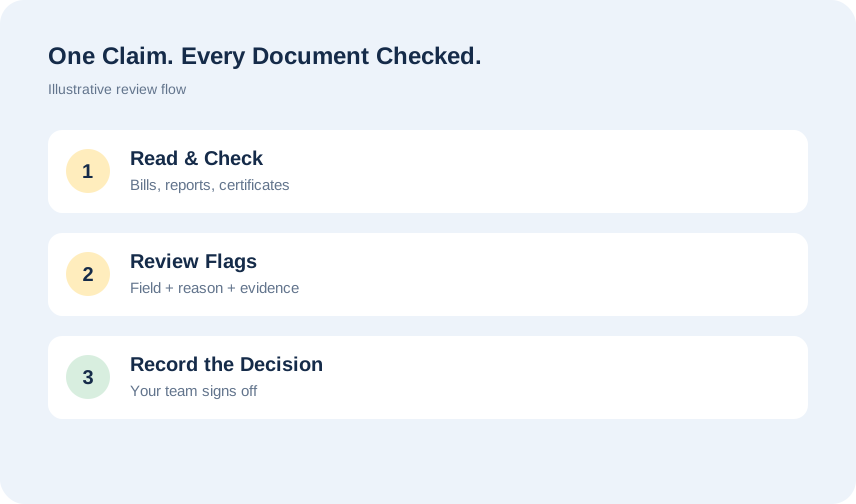
The Insurance Claims & Fraud Triage AI Agent checks documents in the claim file, inside the flow your team already follows.
- Every claim document checked
- Suspicious pages flagged before assessment
- Matched against earlier claims you hold
- Sign-offs in your order, none skipped
- A record you can show in a dispute
Fake Claim Documents Are Cheap to Make and Easy to Miss
Claim scores assess risk. The documents inside a claim need their own checks.

Fakes Cost Nothing Now
Free online generators produce hospital bills marked ready for TPA submission. Edited PDFs and AI-made images can resemble real scans.

Investigators See a Sample
Fraud teams open claims that scores or tips point them to. Other documents can pass without forensic review.

Claims Need to Compare Notes
The same bill, certificate or repair invoice can back two claims months apart. The match is hard to spot in separate files.
What Claims Fraud Costs Insurers Every Year
Estimated annual fraud, waste and abuse leakage in Indian health claim payouts.
BCG and Medi Assist, 2025Estimated annual cost of insurance fraud in the United States.
Coalition Against Insurance Fraud, 2022Of that US estimate is life insurance fraud. Included in the total above.
Coalition Against Insurance Fraud, 2022Vehicle Finance
- Documents processed per month
- 150,000
- Potentially fake or altered documents flagged per month
- ~3,000
- Reported straight-through processing
- 93.3%
Figures cover the full lending workflow, including insurance policies. They are not insurance claims results.
Insurance Policy Checks Inside a Vehicle Lending Workflow
An Indian vehicle lender uses KlearStack to check insurance policies alongside invoices, KYC and vehicle ownership documents. Potentially fake or altered documents and mismatched details go to manual review.
Read the Case Study
The document workload
Live since October 2024, the deployment processes an average of 150,000 documents and 450,000 pages per month. The document set includes insurance policies, invoices, tax receipts, KYC, identity and address proofs, indemnity bonds, customer undertakings, previous-owner consent and vehicle registration certificates.
What gets flagged
KlearStack reports approximately 3,000 potentially fake or altered documents and 10,200 mismatch issues per month. About Rs 60 crore in monthly loan value is associated with the flagged documents. This is associated loan value, not a measure of losses prevented or savings. Flag and mismatch counts may overlap.
How exceptions are handled
The reported straight-through processing rate is 93.3%. Mismatches and suspected fraudulent documents go to manual review and correction. Reported overall accuracy is 99.9%, including that human review and correction.
Why it matters for insurance teams
This deployment shows document checks operating at scale in a workflow that includes insurance policies. An insurer can use a Free Proof of Concept to assess the checks on its own claim files and measure findings and review effort.
Source: operating figures supplied by KlearStack in October 2026. Monthly document and page volumes are averages over the preceding year; flag counts and loan value are approximate. No insurance-policy-only results were supplied. Customer identity withheld for confidentiality.

"We Already Run Fraud Analytics."
Your analytics ranks claims by risk. KlearStack checks the documents in each claim, including the ones your score calls clean.
Test It on Last Month's ClaimsFAQs About
Insurance Fraud
Detection
To detect fraud in insurance claims, check the claim and its documents together. Compare bills, reports and certificates with each other and the policy. Check each page for edits, copied seals and reused papers. Send flagged claims to investigators, with the reason attached.
A Closer Look at Claim Document Checks
Read how document checks support your claims and fraud teams.

Insurance Claims Fraud Detection, Explained
How image forensics, metadata checks and bill math flag tampered claim documents.
Read the Guide
Fraud Monitoring With Document Automation
How claim documents get checked through extraction and forensics before payout.
Read the Guide
Document Fraud Detection
The forensic checks KlearStack runs across document types, in one pass.
Explore the Checks
How AI Spots a Faked Document
The edits, splices and copied regions that can pass a visual check.
Read the GuideSee What Your Claim Files Are Hiding
Start with last month's closed claims. Review the document flags with your investigators before deciding what comes next.
Start a Free Proof of Concept